- Sea Songs, Summer Sunshine and Warm Applause
-
Date Posted: Thu, 9 Jul 2026
On a hot afternoon last Saturday Southampton Choral Society offered an engaging celebration of music inspired by the sea, presented to an appreciative audience of around 80 people, including Councillor Patricia Evemy, the new Lord Mayor of Southampton. The programme combined two contrasting English works: Stanford's Songs of the Fleet, arranged by Musical Director Andrew Hayman, and Elgar's Sea Pictures in Harvey Brough's choral arrangement, with piano solos providing variety between the larger choral works.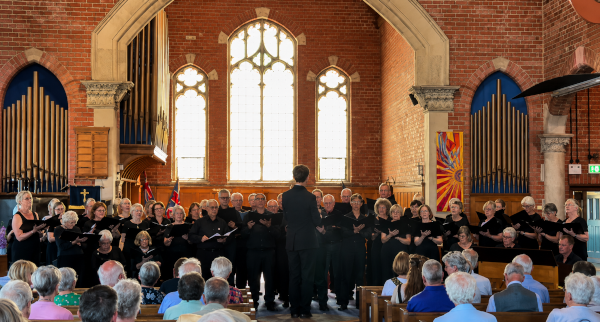
Despite the heat, the choir delivered a committed performance that captured both the vigour of Stanford's nautical writing and the more reflective atmosphere of Elgar's song cycle. The arrangements allowed the chorus to take centre stage throughout, while the piano interludes offered moments of contrast and showcased local musical talent. Although some passages inevitably presented challenges of balance and ensemble, the overall standard was confident and musically convincing.
The two piano interludes provided effective contrasts to the choral repertoire. Hannah Leary, recent winner of the Alban Rees-Jones Cup, gave a poised and expressive performance of Debussy's Jardins sous la pluie, bringing clarity and sparkle to its shifting textures and rhythmic vitality. Later, Musical Director Andrew Hayman performed two contrasting miniatures: Mendelssohn's lyrical Venetianisches Gondellied (Op. 19, No. 6), with its gentle, flowing melody, and MacDowell's evocative From a Wandering Iceberg (Op. 55, No. 2), vividly capturing the imagery suggested by its title.
The audience responded warmly, rewarding the performers with enthusiastic applause. The afternoon concluded with complimentary tea and homemade cake in the church hall, providing an opportunity for performers and audience members to meet informally and rounding off the event in a friendly, welcoming atmosphere. Overall, it was an enjoyable concert that celebrated both Southampton's maritime heritage and the city's vibrant amateur music-making tradition.
As the choir now turn their attention to Mendelssohn's magnificent Elijah, to be performed this November, audiences who enjoyed this summer concert have an exciting opportunity to experience the combined voices of Southampton Choral Society with the Conchord Singers and the Cheriton Singers in one of the great masterpieces of the choral repertoire.

Mendelssohn's Elijah
Where: Chandler's Ford Methodist Church, Eastleigh, SO53 2GE
When: 7.30pm, Saturday, 14 November 2026
Ticket price (including booking fee): £5.39 and £21.56
Tickets (Ticketsource):
Click here to book
Join our mailing list to keep up to date with our activities and events (Mailchimp)
- Fire, Famine and a Fiery Chariot: Why Mendelssohn's Elijah Still Thrills Audiences
-
Date Posted: Mon, 6 Jul 2026
Following our highly successful Summer Concert on Saturday (review), we’re in preparation for our next performance - Mendelssohn’s Elijah. Here’s a taste of the excitement that awaits.
A prophet curses a nation into drought. Fire falls from a clear sky. A man flees into the wilderness, certain he is the last good soul left alive - and is answered not by thunder, but by a voice so quiet it can barely be heard. Then, at the very end, he is swept up to heaven in a chariot of flame.
It sounds like the plot of a blockbuster. It is, in fact, one of the great Victorian oratorios, and on Saturday 14th November, Southampton Choral Society brings Mendelssohn's Elijah to Chandler's Ford Methodist Church, joined for this performance by Cheriton Singers, the Conchord Singers and the Winchester Symphony Orchestra. Three choirs, one almighty sound.
A masterpiece a decade in the making
Mendelssohn first started circling the idea of Elijah in the 1830s, but it took him more than ten years — and a great deal of badgering of his librettist, Julius Schubring — to get the text right. He wanted no static Bible-reading-with-orchestra; he wanted characters who, in his own words, "act and speak as if they were living beings." The result finally reached the stage at the Birmingham Triennial Festival on 26 August 1846, with Mendelssohn himself on the podium — 180 years ago this year.
It was, by any measure, a sensation. The audience interrupted the performance to demand encores for eight separate numbers — an extraordinary occurrence even by the standards of the day. The critics were just as swept away.
Never was there a more complete triumph - never a more thorough and speedy recognition of a great work of art ... altogether one of the most extraordinary achievements of human intelligence — The Times, 29 August 1846.
Handel and Bach, reimagined
Mendelssohn revered both composers, and you can hear it: the weight and grandeur of the choruses owe a clear debt to Handel, while the chorales and contrapuntal writing nod unmistakably to Bach. But Elijah never feels like an exercise in homage. It is Romantic through and through — urgent, theatrical, and emotionally direct in a way that neither of his models quite attempted.
The story
Israel is gripped by famine. Elijah challenges the prophets of Baal to a very public contest of faith — and wins, dramatically, with fire from heaven. Rain finally breaks the drought. Then the story turns inward: Elijah, persecuted and despairing, flees to the wilderness, is comforted by angels, and at last hears God not in wind, earthquake or fire, but in a "still small voice" — one of the most quietly devastating moments in the entire choral repertoire.
What to listen for
The chorus carries much of the drama, transforming across the evening from a frightened, suffering crowd into a body of fervent worshippers. Listen out for:
"Thanks Be to God" — the choir's full-throated release as the drought finally breaks.
"Be Not Afraid" — tender, consoling, and a world away from the storm music either side of it.
The storm and fire sequences — where Mendelssohn's orchestration does as much storytelling as the words.
The hush around the "still small voice" — arguably the emotional heart of the whole work.
Three choirs, one performance
This concert brings together the combined forces of Southampton Choral Society, Cheriton Singers and Conchord Singers providing an unmissable opportunity to hear Elijah's massed choruses sung with real scale and weight, in a work that was, after all, written for exactly that kind of grandeur.
Podcast 02 - Autumn 2026
Narration generated using elevenlabs.io text to speech synthesis processing.
Highlights from "Elijah" performed by The Royal Philharmonic Orchestra and The Royal Choral Society, conduscted by Sir Malcolm Sargeant. via The Internet Archive.
Where: Chandler's Ford Methodist Church, Eastleigh, SO53 2GE
When: 7.30pm, Saturday, 14 November 2026
Ticket price (including booking fee): £5.39 and £21.56
Tickets (Ticketsource):
Click here to book
Join our mailing list to keep up to date with our activities and events (Mailchimp)
- Getting to the Sea Pictures Concert
-
Date Posted: Fri, 3 Jul 2026
We're looking forward to welcoming you to our Sea Pictures Concert. To help make your journey as smooth as possible, here are some travel options.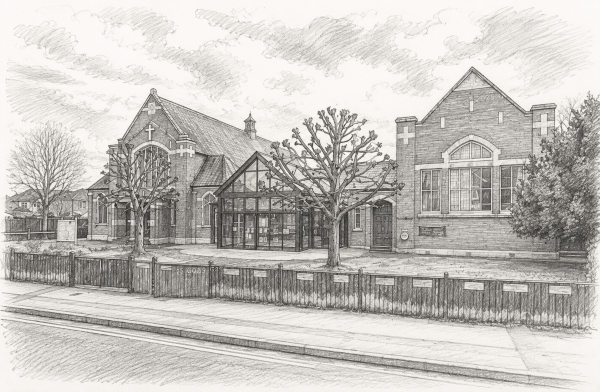
By Train
The church is conveniently located about a 20–25 minute walk from Southampton Central railway station. The route is mostly flat and takes you through the city centre and Shirley area. If you prefer not to walk, local buses and taxis are readily available outside the station.
By Bus
The 17 and 4 Bluestar bus routes serve the Shirley area, which stops at Lidl, just 10 minutes’ walk from St James Road Methodist Church. From Southampton city centre or Southampton Central station, local services towards Shirley provide a convenient option. For the latest timetables and route information, please check with Bluestar before travelling.
By Car
The venue is located on St James Road in the Shirley district of Southampton.
The postcode for satellite navigation is: SO15 5HE
Limited parking may be available on site, and there is usually on-street parking in the surrounding area. As parking availability can vary, we recommend allowing a little extra time to find a space.
Accessibility
The church has benefited from significant accessibility improvements, including lift access and upgraded facilities, helping to make the venue accessible for visitors with mobility needs.
We recommend arriving 15–20 minutes before the performance begins to allow time for parking, finding your seat, and settling in before the music starts.
See you there!
View Larger Map
Where: St James Road Methodist, St James Rd, Shirley, Southampton SO15 5HE
When: 3pm, Saturday, 4 July 2026
Ticket price (including booking fee): £16.17
Tickets (Ticketsource):
Click here to book
Join our mailing list to keep up to date with our activities and events (Mailchimp)
- Celebrate the Sea Through Music at Southampton Choral Society's Summer Concert
-
Date Posted: Sat, 27 Jun 2026
Next Saturday, Southampton Choral Society invites audiences to our Summer Concert – an inspiring afternoon of music celebrating the beauty, power and mystery of the sea.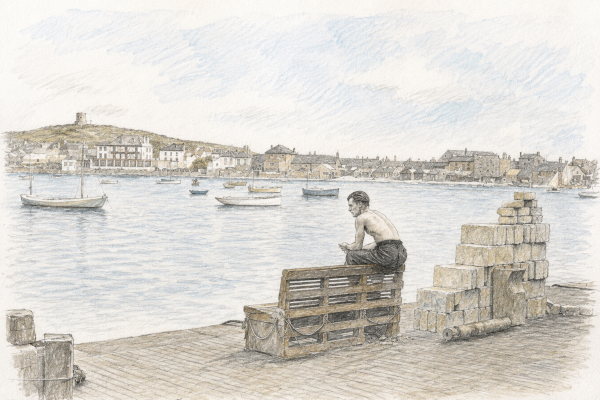
The concert brings together two contrasting English masterpieces. Elgar's Sea Pictures offers moments of lyrical reflection, while Stanford's Songs of the Fleet captures the excitement and adventure of life at sea. Both works have been specially arranged for choir, with Stanford's arrangement created especially for this performance by Musical Director Andrew Hayman, making this a unique opportunity to hear familiar music in a fresh new way.
Adding another watery dimension to the afternoon is a guest performance by Hannah Leary, this year's winner of the Alban Rees-Jones Cup. Hannah, an outstanding young pianist from Southampton, will perform Debussy's atmospheric Jardins Sous la Pluie (Gardens Under the Rain), showcasing the exceptional talent the Society's annual competition was created to support.
Southampton Choral Society has been bringing outstanding choral music to audiences across the region for more than 80 years, and our Summer Concert promises an afternoon of memorable music for seasoned concertgoers and newcomers alike.
With the performance just a week away, now is the perfect time to book your place and enjoy an uplifting musical journey inspired by the sea.
Where: St James Road Methodist, St James Rd, Shirley, Southampton SO15 5HE
When: 3pm, Saturday, 4 July 2026
Tickets: from £5
Tickets (Ticketsource):
Click here to book
Join our mailing list to keep up to date with our activities and events (Mailchimp)
- On This Day: Southampton Choral Society Premieres Freedom
-
Date Posted: Mon, 22 Jun 2026
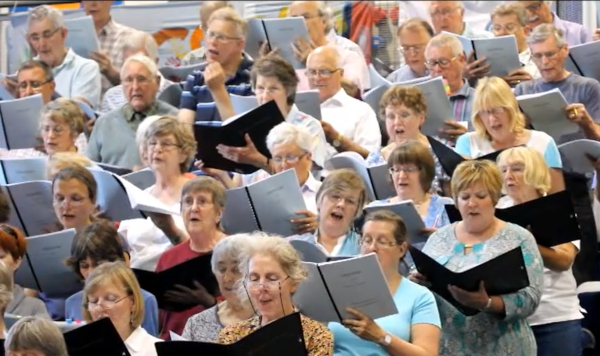
On 22 June 2013, Southampton Choral Society gave the world premiere of Freedom, a major new choral work commissioned by the choir from a £10,000 BBC Community Arts Award to mark one of the most significant milestones in World history: the abolition of slavery across the British Empire in 1833.
Performed at King's Community Church, Hedge End to a capacity audience, Freedom was composed by Ian Schofield with a libretto by Alexander Rhodes. The work was specially commissioned as part of national commemorations marking 180 years since the Slavery Abolition Act came into force. Rather than telling a single story, the piece explores a series of landmark legal cases and parliamentary debates that helped shape the long campaign against slavery.
Among the episodes featured are the famous Sommersett case of 1772, in which an enslaved African man successfully challenged his forced removal from England, and the case of Joseph Knight, whose legal battle in Scotland helped establish that slavery could not be enforced under Scots law. The work also reflects on the political struggles that eventually led to abolition and the long-awaited recognition of the humanity and freedom of enslaved people.
The premiere brought together Southampton Choral Society with conductor Peter Gambie, baritone soloist Joseph Padfield and the Chessel Chanters, Highfield Church Choir, Central Hall Community Gospel Choir, Wyvern Community Choir, Wyvern College Choir and Wyvern College Djembe Drummers to tell this powerful story through music. Combining dramatic narration, choral writing and contemporary musical influences, Freedom invited audiences to reflect on both the injustice of slavery and the courage of those who fought against it.
The commission demonstrated Southampton Choral Society's commitment not only to performing the great choral repertoire but also to creating new works that engage with important historical and social themes. The significance of the project endured beyond its premiere, with the work later recorded live and released on CD, preserving the performance for future audiences.
More than a decade later, Freedom remains a powerful reminder that the abolition of slavery was neither inevitable nor easily won. Its story is one of persistence, legal challenge, public campaigning and human dignity. On this day in 2013, Southampton Choral Society helped bring that history to life through the power of music - a tradition that continues today as the choir explores themes of humanity, resilience and shared experience through choral performance.
Join us at our forthcoming concert to experience another inspiring programme and celebrate the enduring power of music to connect, reflect and inspire.
Where: St James Road Methodist, St James Rd, Shirley, Southampton SO15 5HE
When: 3pm, Saturday, 4 July 2026
Ticket price (including booking fee): £16.17
Tickets (Ticketsource):
Click here to book
Image: Freedom rehearsals (Movement #1: Sommersett's Case), Joe Kaplonek, 2013
Join our mailing list to keep up to date with our activities and events (Mailchimp)
- On This Day – 9 May 1985: A “Buoyant” Bach Finale at Southampton Guildhall
-
Date Posted: Sat, 9 May 2026
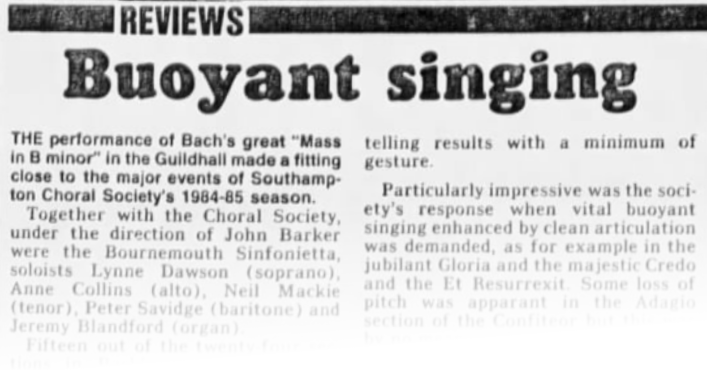
On this day in 1985, Southampton Guildhall was filled with the intricate architecture of sound that defines Johann Sebastian Bach's Mass in B, marking the culmination of the Southampton Choral Society's 1984–85 season. And, according to Eric Wood's account in the Southern Evening Echo, it ended in style.
Wood captured the spirit of the evening with a single word: “buoyant.” That sense of lift and vitality came from singing that was both disciplined and expressive - “clean articulation” underpinning the work's formidable complexity. Under the baton of Bournemouth Sinfonietta's John Barker, the choir navigated one of the most demanding choral works in the repertoire with assurance.
Bach's Mass is no small undertaking. Its 27 sections (15 of them choruses) require precision, stamina, and interpretive clarity. Yet the performance rose to the challenge. The Credo emerged with a sense of majesty, while the Resurrexit carried unmistakable joy. Even a fleeting “loss of pitch” in the Confiteor's Adagio, noted in the review, did little to detract from the overall impact. The impression left was one of cohesion and musical intelligence rather than flaw.
The collaboration extended beyond the choir. The Bournemouth Sinfonietta provided orchestral support described as “alert and reliable,” with particularly strong contributions from the woodwind section. At the organ, Master of the Music of Southampton Parish Church, Jeremy Blandford ensured continuity and depth of texture throughout.
A distinguished quartet of soloists added further polish: soprano Lynne Dawson (who later came to national prominence as soloist at Princess Diana's funeral), tenor Neil Mackie (later head of the Department of Vocal Studies at the Royal College of Music), alongside alto Ann Collins and bass Peter Mardle. Their contributions helped shape the Mass into a fully realised dramatic and spiritual experience.
Looking back, this concert stands as a reminder of what our society can achieve when ambition meets preparation. Ending a season with Bach's Mass in B Minor is a statement in itself. Delivering it with passion, clarity, and conviction - that is something worth celebrating.
As we look ahead, that same sense of musical “floatability” is set to carry forward into Sea Pictures - our next concert on 4 July. With a nautical-themed programme promising rolling melodies and oceanic atmosphere, audiences can expect an evening designed to lift spirits and stay afloat in the imagination long after the final note. If May 1985 showed how Bach's music can rise and resonate, July's concert looks ready to make waves of its own - so it's well worth securing your place.
Where: St James Road Methodist, St James Rd, Shirley, Southampton SO15 5HE
When: 3pm, Saturday, 4 July 2026
Ticket price (including booking fee): £16.17
Tickets (Ticketsource):
Click here to book
Image: Review - Buoyant Singing, Southern Evening Echo, 15 May 1981.
Join our mailing list to keep up to date with our activities and events (Mailchimp)
- Where the Sea Sings: What to Listen for at Southampton Choral Society’s Summer Concert
-
Date Posted: Thu, 30 Apr 2026
On the afternoon of 4 July, at St James Methodist Church Southampton, we turn our focus to the sea - its beauty, its danger, and its deep emotional pull. This thoughtfully shaped programme pairs two major English works: Edward Elgar’s Sea Pictures in a choral arrangement by Harvey Brough, and Charles Villiers Stanford’s Songs of the Fleet arranged by our musical director, Andrew Hayman. Both draw on maritime imagery, but they speak in strikingly different musical voices. Knowing what to listen for can make the experience even more absorbing.
Elgar reimagined: Sea Pictures
Elgar’s Sea Pictures (1899) is often heard as a solo work, its five songs unfolding as an intimate reflection on the sea and the human spirit. In Brough’s choral arrangement, that intimacy expands into something more communal - less a single perspective, more a shared emotional landscape.
Harvey Brough recalls discovering the songs almost by accident while working on a seaside-themed opera project and being immediately struck by its quality. The idea to arrange it for choir emerged later, prompted by a contrasting programme with jazz singer Liane Carroll and the realisation that the work had entered the public domain. Rather than use an existing arrangement, he chose to create his own under tight time pressure, completing it in just two days. Despite the speed, he approached the task with care, aiming to preserve the detail of Elgar’s original while redistributing the musical material across the choir, giving each voice both melodic and supportive roles.
As Brough himself recalls of the process, “it was a joy to arrange… I tried to get every detail from Elgar’s original correct in the voice part and piano.” That balance, between fidelity and reimagining, is central to what you’ll hear in performance.
What to listen for:- Wave-like phrasing: Notice how musical lines rise and fall across the choir. Elgar’s melodies are long and fluid; here, they pass between voices, creating a sense of ebb and flow.
- Text painting: Elgar is meticulous in matching music to words. Listen for moments where harmony darkens on images of depth or uncertainty, then brightens as the poetry turns toward light or hope.
- Blended sonority: Without a soloist at the centre, the expressive weight lies in the ensemble. Pay attention to how the choir balances clarity of text with a unified, almost orchestral sound.
- Shifts in mood: Each of the five songs has its own character, from reflective calm to quiet intensity. The transitions between them are subtle but telling.
Where Elgar reflects, Stanford narrates. Songs of the Fleet (1910) is one of Stanford's most vividly crafted choral works, a sequence of five movements set to poems by Henry Newbolt that celebrate the character, discipline, and mythology of the Royal Navy at the height of the Edwardian era. Newbolt’s verses move between stirring patriotism and reflective lyricism, and Stanford responds with music that is both robustly maritime and richly expressive. From the commanding sweep of Sailing at Dawn to the contemplative tribute of The Middle Watch and the exuberant energy of The Little Admiral, the cycle traces a broad emotional arc, evoking the sea not only as a physical force but as a symbol of national identity and human endeavour.
Stanford in full sail: Songs of the Fleet
Originally conceived for baritone soloist, chorus, and orchestra, the work has been newly arranged for a SATB choir and piano by our Musical Director Andrew Hayman. As Andrew explains, “this arrangement retains Stanford’s narrative clarity and musical vitality, allowing the collective voice of the choir to carry Newbolt’s imagery with directness and warmth.”
What to listen for:- Call-and-response writing: The chorus parts often answer or reinforce each other. Listen for these exchanges. They give the music a sense of dialogue and collective identity.
- Rhythmic drive: Stanford uses strong, propulsive rhythms to evoke movement - ships cutting through water, wind filling sails. These passages bring energy and momentum to the performance.
- Choral storytelling: The choir represents the voice of the fleet itself. Notice how it shifts character, from bold and declamatory to hushed and atmospheric.
- Contrasts in texture: Stanford alternates between full, powerful sections and more transparent moments. These contrasts help shape the narrative arc across the five songs.
Set in a city shaped by maritime history, this concert offers more than a performance. It’s an opportunity to hear the sea rendered in sound: sometimes distant and contemplative, sometimes immediate and alive.
Where: St James Road Methodist, St James Rd, Shirley, Southampton SO15 5HE
When: 3pm, Saturday, 4 July 2026
Ticket price (including booking fee): £16.17
Tickets (Ticketsource): Click here to book
Podcast 01 - Summer 2026
Audio generated using elevenlabs.io text to speech synthesis processing.
Elgar’s Where Corals Lie, piano accompaniment by Domenico Ricci
Stanford’s The Little Admiral recreated from an SCS rehearsal recording using openmusic.ai.
Seagulls sound effect by u_up4clmd95a from Pixabay.
Join our mailing list to keep up to date with our activities and events (Mailchimp)
- On This Day, 1944: Southampton Choral Society’s First Concert
-
Date Posted: Mon, 20 Apr 2026
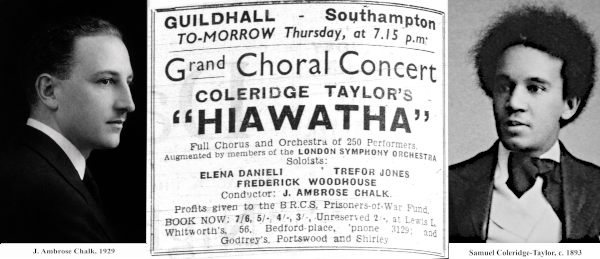
On this day in 1944 what would become the Southampton Choral Society gave its first performance. Led by our founder, accomplished organist J Ambrose Chalk (1905-1994), the new choir opened its account with an undertaking of real scale, a full performance of Samuel Coleridge-Taylor’s Hiawatha at the Guildhall.
The concert did not come about easily. Wartime conditions made even routine rehearsals complicated, with members juggling work, civil duties and the disruption of daily life. As one contemporary report noted, rehearsal difficulties alone “must be a conductor’s nightmare.” Yet the organisers persisted, assembling a large choir drawn from Southampton and Chandlers Ford, supported by an orchestra combining local musicians with a small number of professionals.
There was also a strong sense of purpose behind the event. The performance was given in aid of the British Red Cross and the St John’s Prisoners of War Fund. Music here was not only cultural but contributed to wartime fundraising and morale building.
The choice of work was significant. English composer Coleridge-Taylor’s Hiawatha trilogy had been one of the most popular large-scale choral works in Britain since its premiere at the turn of the twentieth century. Based on Longfellow’s epic poem, it combines memorable melodies with vivid storytelling and a strong sense of atmosphere. Coleridge-Taylor achieved remarkable success with the work, and for decades it was performed widely by amateur and professional choirs alike – as it still is today. By 1944, it was very well known and had a proven ability to bring large forces together and engage broad audiences. For our newly formed society, it was both an ambitious and a practical choice.
The scale of the occasion reflected that ambition. Around 220 performers took part, including a choir of roughly 160 voices. The soloists, American soprano Elena Danieli (1899 – 1985), tenor Trefor Johns (1902-1965) and baritone Frederick Edwin Woodhouse (1892-1966) were well known to the audience. Under Chalk’s direction the ensemble achieved a level of unity that drew praise from the press. The demands of the score are considerable, requiring sustained energy and careful coordination, yet the performers were judged to have met them with assurance.
The audience response matched the effort on stage. The Guildhall was filled with an attentive crowd of around 1,200 people, among them many American servicemen stationed in the area as part of Operation Overlord. Their presence contributed to a distinctive atmosphere, and reports suggest that the overall reception was warm and enthusiastic, reflecting a public eager for shared cultural experience in difficult times.
A contemporary press report captured both the achievement and its context: “a choir and orchestra of 220 gave an exceedingly good choral presentation – one which reflected great credit not only on singers and players but also on those responsible for the organisation and arrangement.”
This first concert established a solid foundation for our newly formed choir. In a city where daily life was shaped by war, a large body of performers came together, tackled a demanding work, and drew a substantial audience. That combination of ambition, organisation and community support set the tone for everything that followed.
Our second concert took place the following January at the Guildhall which once again was filled to capacity, despite the deep snow outside. The programme included Stanford's Songs of the Fleet, which, unlike Hiawatha, became a regular part of our repertoire - and which we are performing in July along with Elgar’s Sea Pictures.
Image: AI enhanced newsprint photo of J Ambrose Chalk (Southern Daly Echo, 26 February, 1929), Hiawatha performance notice (Southern Daly Echo, 19 April, 1944), and photo of Samuel Coleridge-Taylor (via Wikimedia Commons).
Join our mailing list to keep up to date with our activities and events (Mailchimp)
- Find Your Voice (and Your People) with Southampton Choral Society
-
Date Posted: Wed, 8 Apr 2026
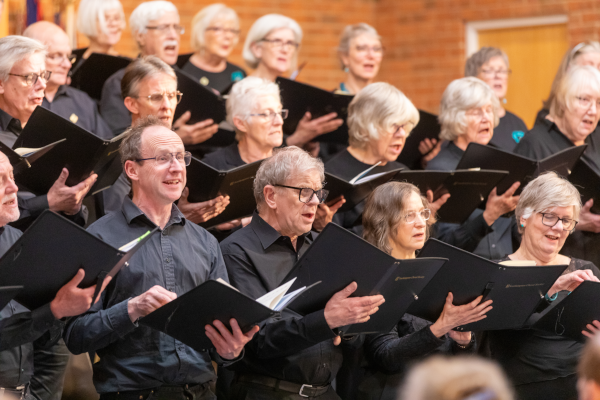 There’s something about hearing a room full of people singing together that just stops you in your tracks. If you’ve ever felt that pull, it might be time to stop walking past and actually step inside.
We’ve been part of the local music scene for over 80 years - but don’t let that fool you into thinking we’re stuffy or exclusive. We’re a genuinely welcoming group of people who just like to sing…and want more people to join in.
It’s not just about singing (honestly)
You don’t need to be a professional singer. You don’t even need to be that confident. Plenty of members started out only singing in the car or the shower.
What keeps people coming back isn’t just the music - it’s the people.
Turning up on a Monday night quickly becomes less about rehearsal and more about seeing familiar faces, having a laugh, and feeling part of something. In a world where everything is increasingly online and disconnected, that kind of in-person community is rare - and surprisingly powerful.
It does your brain (and mood) a favour
Singing is one of those activities that sneaks up on you. You arrive a bit tired, maybe a bit stressed… and leave feeling noticeably better.
That’s not just in your head. Singing has been shown to reduce stress, improve mood, and help you properly switch off from the day. When you’re concentrating on harmonies, watching the conductor, and trying to come in at the right moment, there’s no space left for your to-do list.
And when it all comes together? That moment where the sound just clicks? It’s hard to beat.
You’ll be more capable than you think
One of the most surprising things about joining a choir is how quickly you improve. Week by week, you start to recognise patterns, feel more confident, and handle music you’d never have attempted before.
We tackle everything from powerful classical works to more contemporary pieces, so you’re not just repeating the same old songs - you’re actually learning something new each term.
No pressure, just progress.
Give it a go
If any of this sounds appealing, the easiest thing to do is just turn up and try it.
When: Monday evenings, 7:15 pm
Where: St James Road Methodist Church Hall, St James Road, Shirley, Southampton, SO15 5HE
You don’t need to commit on day one. Just come along, see how it feels, and decide from there.
Worst case? You’ve spent an evening listening to some good music.
Best case? You’ve found a new hobby - and a group of people - you didn’t realise you were missing.
Please contact our Membership Secretary, Rosaleen Wilkinson: membership@southamptonchoralsociety.org.uk
Join our mailing list to keep up to date with our activities and events (Mailchimp)
- OTD 3 April 1826 - A Concert of “Ancient and Modern Music” Announced
-
Date Posted: Fri, 3 Apr 2026
On this day in 1826, a notice appeared in the Southampton Town and County Herald announcing what was billed as the "first public concert” of a Southampton Choral Society. Nearly two centuries later, as the present-day Society (founded in 1944), we read this programme with both recognition and curiosity: recognition in the enduring pillars of choral music, and curiosity at a repertoire shaped by very different tastes and expectations.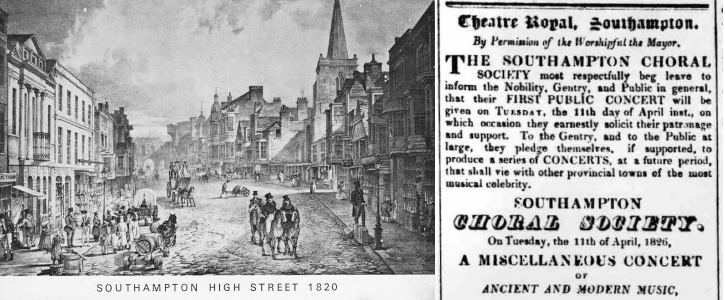
The 1826 concert promised a “miscellaneous concert of ancient and modern music” - a phrase that, in its time, spanned composers we would now firmly classify as Baroque and Classical. Names like George Frideric Handel, and Joseph Haydn appear prominently, forming the backbone of the evening. The inclusion of the “Hallelujah” Chorus and multiple excerpts from Handel’s oratorios underscores how central sacred choral works already were to communal music-making, something that remains true for us today.
Yet the rest of the programme reveals a striking contrast. Alongside these now-canonical figures sit composers such as Antonio Salieri, Carl Maria von Weber, and François-Adrien Boieldieu, represented not by full-scale works but by excerpts, overtures, glees, and songs. The prevalence of glees, a distinctly British part-song tradition, points to a social, almost domestic style of choral singing that differs markedly from the large-scale choral-orchestral works we tend to prioritise today.
Modern choral societies, including our own, typically programme substantial unified works: a complete oratorio, a mass setting, or a themed concert. By contrast, the 1826 audience experienced variety as the central appeal - short forms, operatic highlights, instrumental concertos, and even an “Indian Air” arranged for local taste. It was less about immersion in a single composer’s vision and more about showcasing breadth, novelty, and accessibility.
And yet, there is continuity. The ambition expressed in that 1826 notice, to “vie with other provincial towns of the most musical celebrity”, still resonates. Today’s choral landscape is broader, incorporating contemporary composers, global traditions, and historically informed performance. But the essential impulse remains unchanged: to bring people together through shared musical experience, balancing heritage with discovery.
Further reading
From The Southampton Town and County Herald,
Monday, April 3, 1826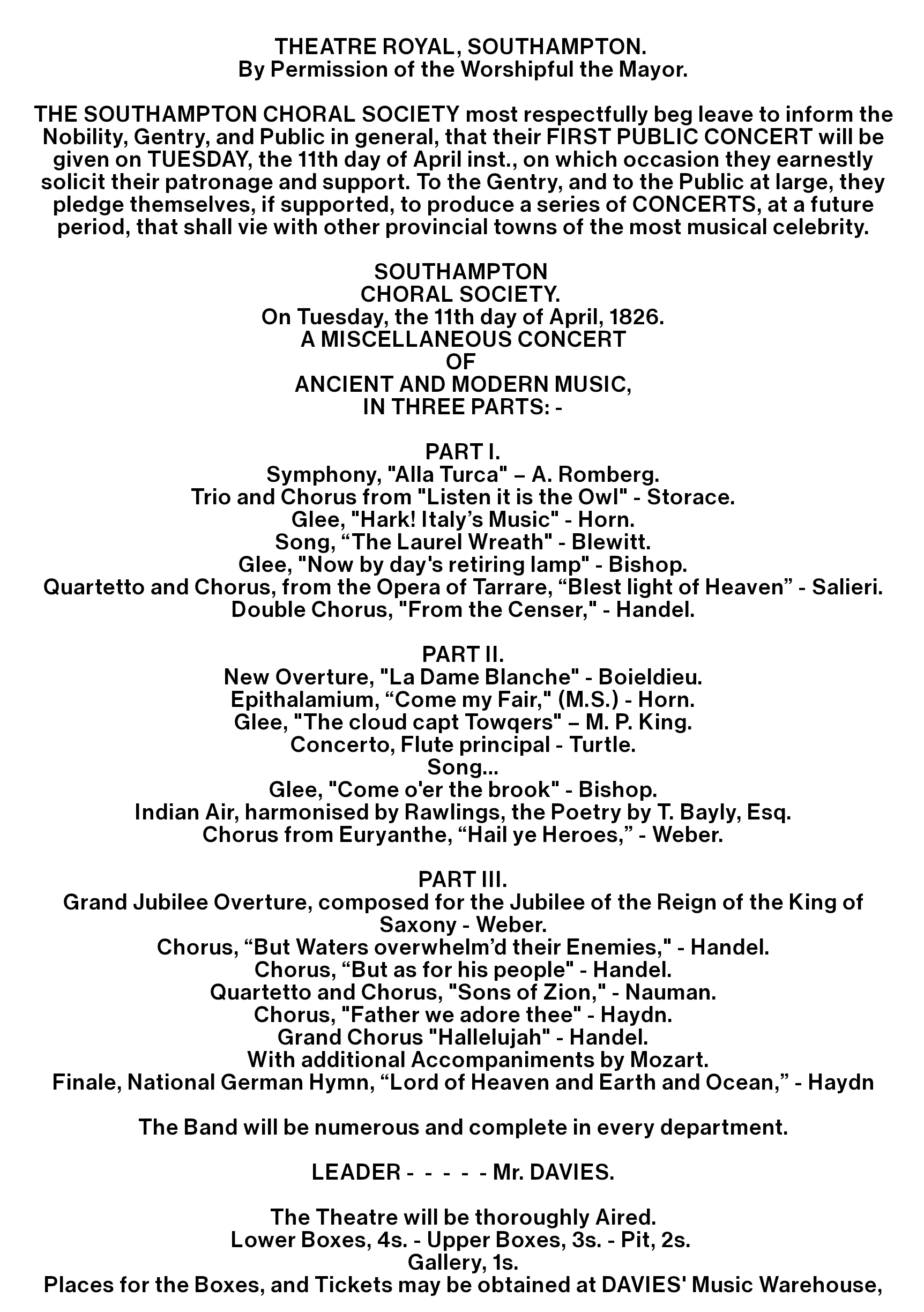
Join our mailing list to keep up to date with our activities and events (Mailchimp)
- Southampton Choral Society Excels With Confident Voices and Bold Choices
-
Date Posted: Tue, 31 Mar 2026
Southampton Choral Society opened their programme at Chandlers Ford Methodist Church on Saturday with an ambitious and confident first exploration of Cecilia McDowall’s Da Vinci Requiem.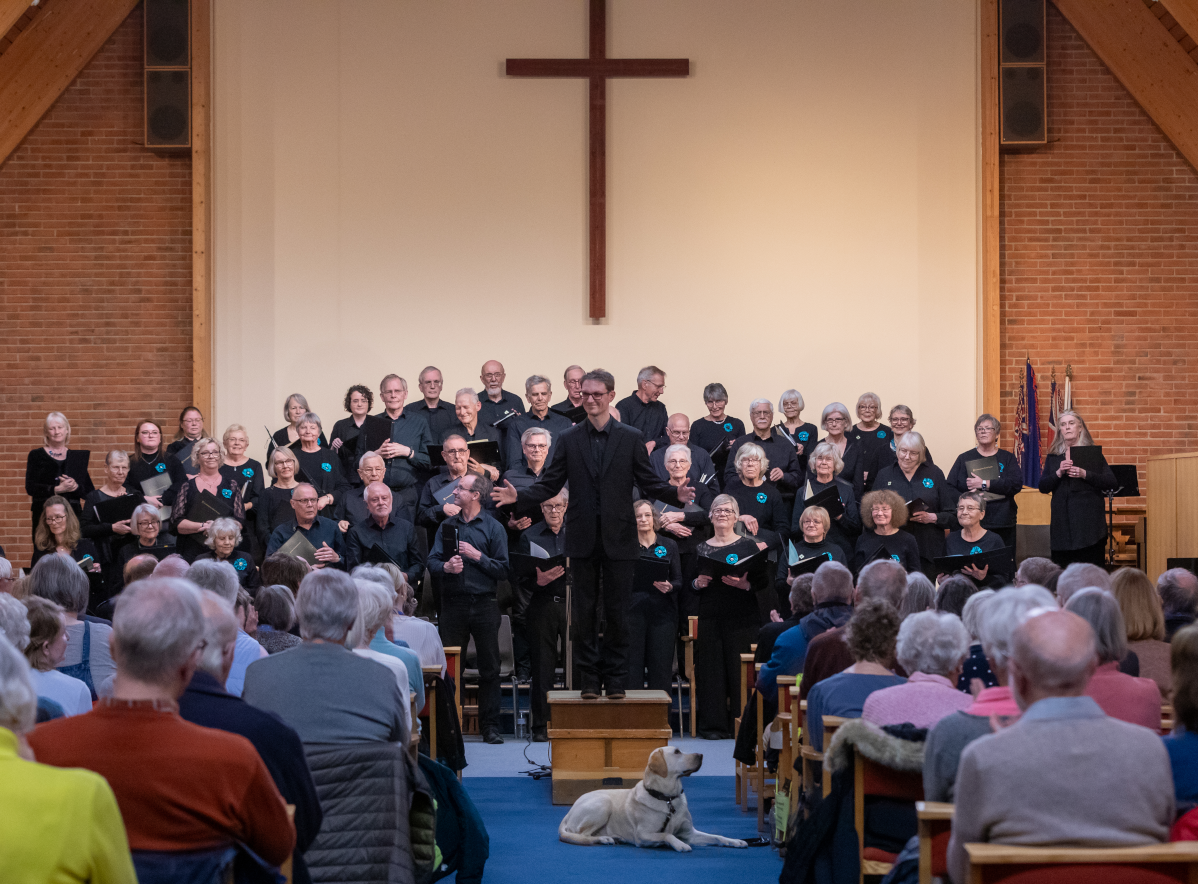
Tackling such a complex contemporary work demonstrated both commitment and musical curiosity, and under Andrew Hayman’s assured leadership the choir delivered a performance of growing confidence and cohesion. As the piece unfolded, the ensemble settled into its distinctive rhythmic and harmonic language, shaping the work with increasing clarity and purpose. It was a pleasure to hear it come together with soloists Jenni Harper (Soprano), and Oliver Turner (Baritone), who sang with great poise - contributing to a compelling overall sound world.
This was followed by pianist David Hall’s sensitive performance of Automne by Cécile Chaminade, offering a particularly enjoyable and contrasting interlude before the choir returned to complete the second half of the Requiem with continued conviction. Taken as a whole, this was an impressive and rewarding first encounter with a demanding work, warmly appreciated by an audience of around 150, whose response reflected both engagement and admiration. The Da Vinci Requiem is a piece that clearly merits a place in the choir’s growing repertoire.
Following the interval, the second half showcased the choir’s stylistic versatility, moving into Baroque repertoire with vigour and polish. Isabella Leonarda's Dixit Dominus was delivered with confidence and expressive clarity, clearly playing to the choir’s strengths.
A lively intermezzo featured Andrew Hayman in an exuberant organ performance of Emma Lou Diemer’s Fiesta, adding rhythmic vitality and flair to the evenings enjoyment.
The programme concluded with a particularly strong Vivaldi Gloria. There were moments of beautifully unified ensemble singing, and the choir captured the energy, bounce, and dance-like character with real style. Joined by mezzo-soprano Jenny Samuel, alongside Jenni Harper, the performance was both confident and uplifting, bringing the evening to a satisfying close
The inclusion of works by four women composers (McDowall, Chaminade, Leonarda and Diemer) was a thoughtful and fitting way to mark International Women in Music Day, highlighting both their artistic contribution and enduring influence within the choral repertoire.
Join our mailing list to keep up to date with our activities and events (Mailchimp)
- Tonight’s International Women in Music Day Performance
-
Date Posted: Sat, 28 Mar 2026
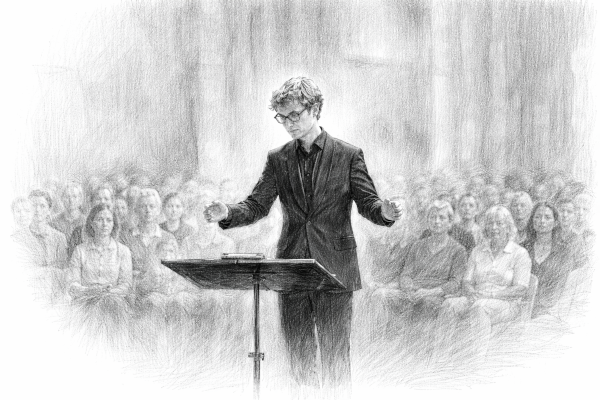 This evening, we present a programme that balances familiar repertoire with a more recent addition: Antonio Vivaldi’s Gloria, Isabella Leonarda’s Dixit Dominus, and the contemporary Da Vinci Requiem by Cecilia McDowall.
Vivaldi’s Gloria is one of the society’s most frequently revisited works, performed seven times between 1944 and 2024. From the Guildhall to Beaulieu Abbey, it has remained a consistent feature of the choir’s programming, valued for its energy, clarity, and enduring popularity. This evening’s performance continues that established tradition.
Leonarda’s Dixit Dominus, while less frequently performed, is not new to the choir. It was last presented in 2017, and its return offers a chance to revisit a distinctive Baroque voice that sits outside the more commonly performed canon. As a composer, Leonarda represents an important but often overlooked strand of 17th-century sacred music, and the inclusion of her work reflects the society’s interest in exploring a broader historical repertoire.
In contrast, Cecilia McDowall’s Da Vinci Requiem marks a first for the society, making it the most forward-looking element of the programme. Combining the traditional Requiem text with reflections inspired by Leonardo da Vinci, it introduces a contemporary tonal and thematic dimension.
Overall, this evening’s concert brings together three different perspectives: a well-established favourite, a returning but less familiar Baroque work, and a modern composition new to the choir’s repertoire.
Tonight, we will be joined by soloists Jenni Harper (Soprano), Jenny Samuel (Mezzo-Soprano), and Oliver Turner (Baritone) with David Hall providing piano accompaniment.
Tickets will be available on the door, but to guarantee a seat book them online now.
- Getting to the Gloria Concert – A Quick Guide
-
Date Posted: Thu, 26 Mar 2026
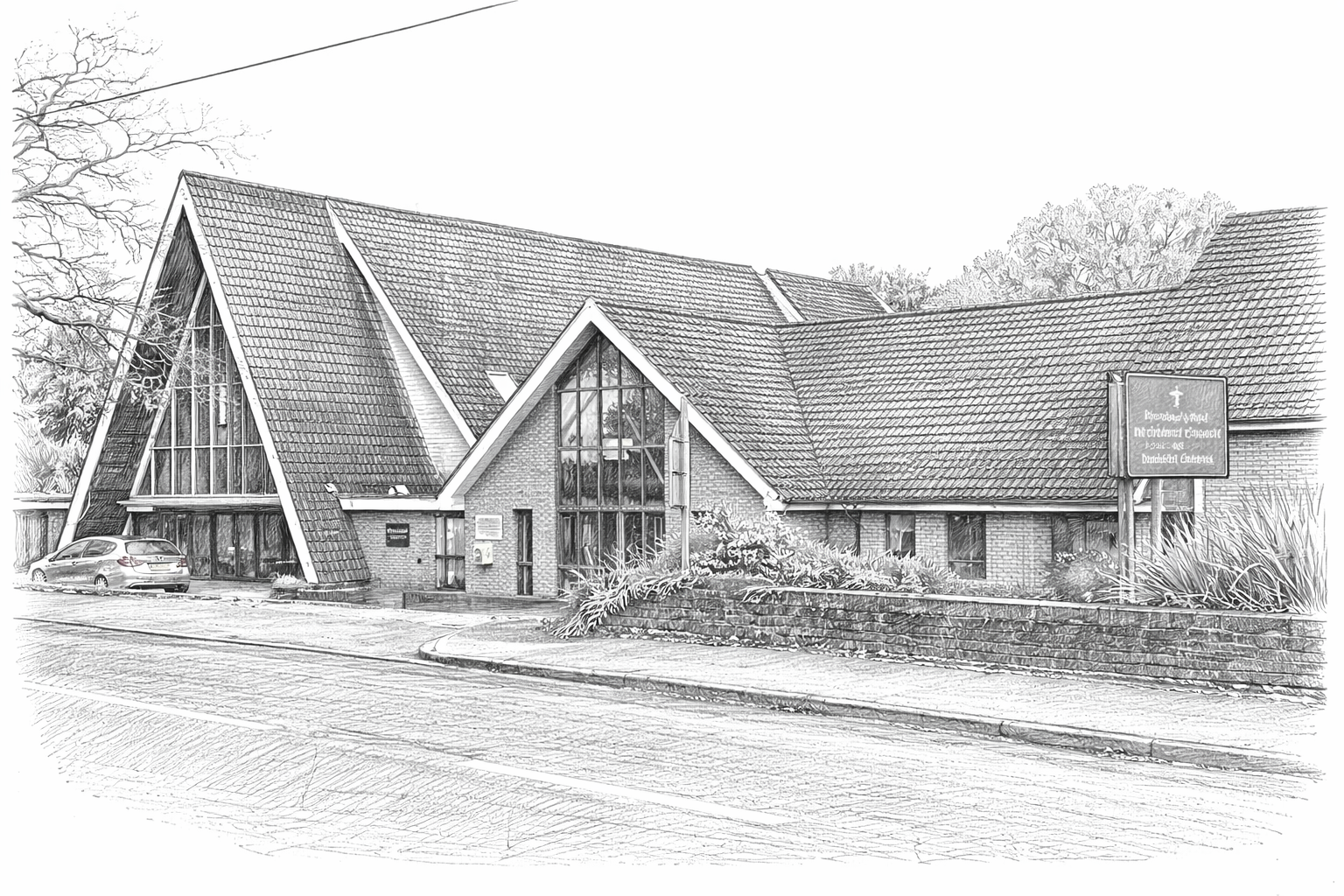
If you’re coming to our “Gloria” concert at Chandlers Ford Methodist Church (SO53 2GJ) on Saturday 28 March (19:30–22:00), here’s a simple guide to help you plan your journey.
By Bus
The church is conveniently located on the Bluestar 1 route, which runs between Southampton and Winchester and stops in Chandlers Ford.
• This is the most straightforward public transport option.
• Buses run regularly in the evening.
After the concert (finishing ~22:00):
Evening buses continue to run roughly every 30 minutes. Typical departures towards Southampton are around:
• 21:57
• 22:27
• 22:57
(Exact stops and times may vary slightly, so it’s worth checking live timetables on the day.)
Parking
Parking is straightforward and free, with several options nearby:
• Behind the church – limited spaces available on site.
• Nearby supermarket car park: Waitrose in Oakmount Road, SO53 2LG (ground-level parking only, a short walk away)
• Additional on-street parking is available in surrounding residential roads.
By Train
The nearest station is Chandlers Ford, about a short taxi ride or a longer walk from the church. The station has step-free access and basic facilities.
However, for this evening event, buses or driving are usually more convenient than rail.
Practical Tips
• If you’re local, the Bluestar 1 bus is the easiest option—no parking concerns.
• If driving, aim to arrive a little early as the church car park is small.
• After the concert, there are still regular buses back towards Southampton, so you won’t be stranded.
Overall, access to the venue is relatively easy, whether you choose public transport or to drive. We look forward to seeing you!
Ticket information: www.ticketsource.co.uk/southamptonchoralsociety/t-qmvedqm
View Larger Map
- Soloists Announced for Upcoming Southampton Choral Society Concert
-
Date Posted: Wed, 18 Mar 2026
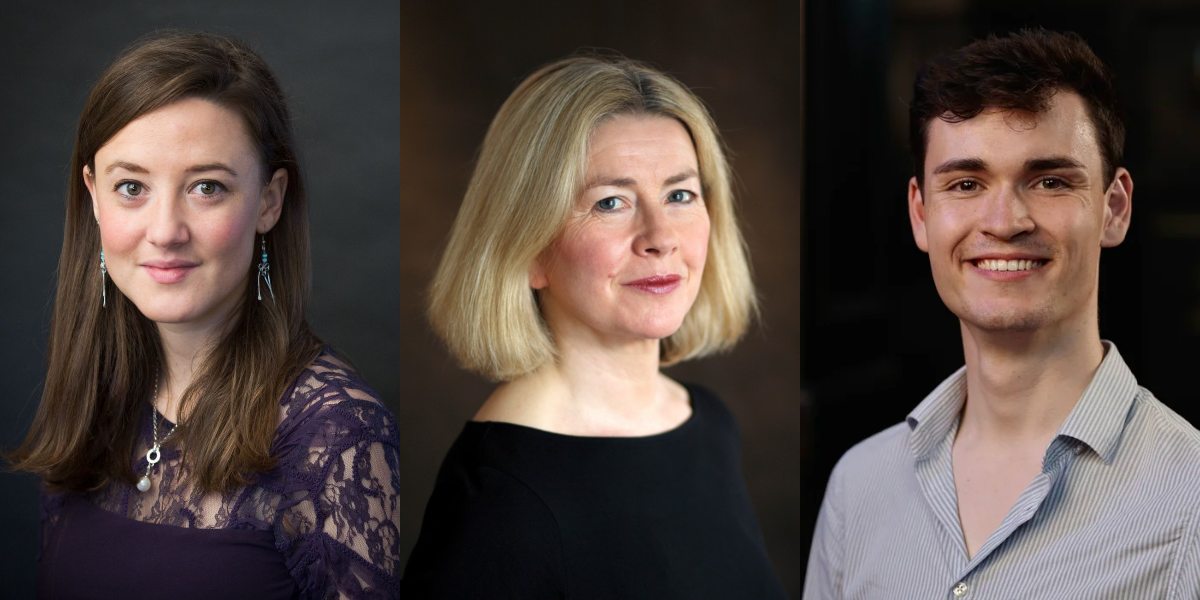
We are delighted to announce the lineup of distinguished soloists for our upcoming concert at Chandler’s Ford Methodist Church on Saturday, 28 March. In celebration of International Women in Music Day, the evening will feature soprano Jenni Harper, mezzo-soprano Jenny Samuel, and baritone Oliver Turner in a programme bridging the gap between Baroque brilliance and contemporary imagination.
The concert highlights include Vivaldi’s Gloria, Isabella Leonarda’s Dixit Dominus, and the centrepiece of the evening: Cecilia McDowall’s Da Vinci Requiem. This modern masterpiece weaves Latin texts with entries from Leonardo da Vinci’s private notebooks to explore humanity's connection to the natural world.
Meet the Soloists
Jenni Harper (Soprano) Described by The Times as "characterfully sung" and by Opera Today for her "fine focus and strong dramatic presence," Jenni Harper is a Britten-Pears Young Artist who graduated with distinction from the Guildhall School of Music and Drama. Her recent highlights include performances with the Academy of Ancient Music and the London Mozart Players, as well as lead operatic roles such as Euridice in Monteverdi’s Orfeo.
Jenny Samuel (Mezzo-Soprano) A highly experienced freelance opera singer and Part-Time Lecturer at the University of Southampton, Jenny Samuel has performed with prestigious companies including the English National Opera, English Touring Opera, and Buxton Festival Opera. Her extensive repertoire includes roles such as Katisha in The Mikado, Marcellina in The Marriage of Figaro, and the title role in La Cenerentola. She is also a well-known vocal educator across Hampshire.
Oliver Turner (Baritone) Hailing from Manchester, Oliver Turner currently serves as a Lay Clerk at Guildford Cathedral and is a young artist with the Oxford Bach Soloists. A former student of Chetham's School of Music and the University of York, Turner is also active in vocal leadership, working with organizations such as the Royal School of Church Music and Gabrieli Roar.
Concert Accompanist
David Hall (Organ) Studied the piano with Laura Cole and Freni Cha and the organ with Anne Marsden Thomas at the Royal Academy of Music. In 1996, he was appointed organ scholar at Corpus Christi College, Cambridge. In the following years, he played regularly at Chelmsford Cathedral and became Director of Music at Twyford School in Hampshire and Musical Director of Finchcocks Piano Courses in Kent.
A Night of "Spicy Rhythms and Colours"
Musical Director Andrew Hayman describes the programme as ambitious music that "constantly tweaks the ear with its spicy rhythms and colours". The evening promises an emotional journey, moving from the joyful energy of Vivaldi to the "luminous, hopeful conclusion" of McDowall’s Requiem, where voices and violins fade away in a musical tribute to Da Vinci’s theories on perspective.
Event Details
- What: Southampton Choral Society: International Women in Music Day Concert
- When: 7:30pm, Saturday, 28 March
- Where: Chandlers Ford Methodist Church, Chandlers Ford, SO53 2GJ
- Tickets: Under 18s: £5, Adults: £16. Available via Ticket Source at www.ticketsource.co.uk/southamptonchoralsociety
- Celebrate International Women in Music Day with the Southampton Choral Society
-
Date Posted: Mon, 9 Mar 2026
Get ready for a night where centuries of music meet in one unforgettable concert. To celebrate International Women in Music Day, the Southampton Choral Society welcomes audiences to Chandler’s Ford Methodist Church for an inspiring programme that travels from the brilliance of the Baroque to the bold imagination of contemporary music.
The evening opens with two luminous works from the Italian tradition: Vivaldi’s Gloria (composed for the girl's choir at a Venetian orphanage) beloved for its joyful energy and radiant melodies, and Isabella Leonarda’s Dixit Dominus, a powerful reminder of the expressive richness of early sacred music. Together, these works set the stage for the concert’s centrepiece - a modern composition that challenges, surprises and deeply moves.A Modern Requiem Inspired by Genius
At the heart of the programme is Cecilia McDowall’s Da Vinci Requiem, a work as intellectually fascinating as it is hauntingly beautiful. Commissioned to mark the 500th anniversary of Leonardo da Vinci’s death in 1519, this is not a traditional Requiem. Rather than focusing on judgment and wrath, McDowall reimagines the form by reflecting on humanity’s place within the natural world.
She weaves together the Latin text of the Missa pro defunctis with excerpts from Leonardo’s own notebooks - intimate, curious writings that reveal his thoughts on nature, art and existence. The result is music that feels both ancient and strikingly modern.
McDowall, one of Britain’s most acclaimed contemporary composers, has been captivated by Leonardo’s notebooks since childhood. That lifelong fascination shines through in a score that balances dark contemplation with rhythmic vitality and flashes of unexpected beauty.What to Listen For
The Da Vinci Requiem unfolds in a distinctive “arch” shape, carrying listeners on an emotional journey. It begins with a deep, flowing line in the lower instruments, creating an atmosphere that is quietly unsettling. As the work progresses, moments of sharp-edged dissonance emerge, including sliding strings that add tension and urgency.
Gradually, the music rises to a powerful high point before easing into a luminous, hopeful conclusion. In the final moments, voices and violins seem to drift upward and fade away - a musical nod to Leonardo’s own ideas about perspective and disappearance.An Invitation from the Choir
Known for both musical excellence and social conscience, the Southampton Choral Society relishes ambitious programmes like this one. Musical Director Andrew Hayman describes the experience as “music that constantly tweaks the ear with its spicy rhythms and colours.”
Whether you come for Vivaldi’s familiar brilliance or to discover how Leonardo da Vinci’s sketches can be transformed into sound, this promises to be a concert that lingers long after the final note.
When: 7:30pm, Saturday, 28 March
Where: Chandler’s Ford Methodist Church
Tickets: £5.39 - £17.25 (price incl. booking fee) Ticket Source
Rehearsals are always open to the public - and full of passion and energy. We’d love to see you there.
For more information, see: www.ticketsource.co.uk/southamptonchoralsociety/t-qmvedqm
- Good Luck Claudia
-
Date Posted: Tue, 23 Jul 2024
We say thank you and good luck for the future to Claudia Grinnell our accompanist who is taking up her new job as Director of Music at St Edmondsbury Cathedral in Suffolk..
- Close links with other singers
-
Date Posted: Tue, 23 Jul 2024
In September Sopranos and Altos from SCS are joining with the Conchord singers to sing Holst's The Planet Suite in aid of the Princess Anne Hospital. Come and hear us at Romsey Abbey on the 21st September.
- Haydn: The Creation.
-
Date Posted: Tue, 23 Jul 2024
Southampton Choral Society are joining the Conchord Singers in a joint performance of The Creation on Saturday 15th February 2025.